There are rooms you walk into and immediately sense that something meaningful is about to happen. This is the atmosphere I find most common during sessions for NextGen Board Leadership development. The energy is palpable, not the nervous kind that precedes a high-stakes presentation, but something quieter and more profound. It is the kind of energy that emerges when human beings arrive, genuinely, as themselves, ready to bridge the gap between legacy and the future of effective governance.
That is precisely the quality of the room I walked into yesterday. Twelve plus third-generation leaders gathered around the same table, some already familiar with one another from shared histories of family and enterprise, others meeting for the very first time. And yet, within the first hour, the distinction between ‘long-known’ and ‘newly met’ had quietly dissolved. What remained was something rarer: a shared honesty. Around this table, each of them had the courage to hold up their aspirations to the light, not the polished, boardroom-ready version of those aspirations, but the real ones. The innovative ones. The ones that had been quietly waiting for the right climate to be spoken aloud.
What brought the room to life was not a curriculum or a case study. It was a single, well-placed question, the kind that a skilled coach offers not to interrogate, but to illuminate. “What is the dream you are carrying for this company in 2035?” In that pause after the question, something shifted. One by one, these leaders began to speak of modernizing legacy, of expanding across new frontiers, of honoring what their grandparents built while refusing to be imprisoned by it. They spoke of sustainability not as a compliance exercise, but as a personal commitment. They spoke of sibling companies and subsidiary futures. They spoke of one another.
By the time we reached the close of the day, something remarkable had happened. These innovative leaders had moved from the careful courtesy of first meetings to the warmth of genuine camaraderie. They concluded not with polite applause or a formal vote of thanks, but with an anthem; the ancient, joyful rallying cry of the Three Musketeers: “One for all, and all for one.” In that moment, it was no longer a phrase. It was a declaration. A covenant. I saw in their faces not the careful composure of boardroom leaders, but the open, committed, “Let’s go change the world” expressions of people who had decided to trust each other. That, in my experience as a coach, is where transformation truly begins.
Why NextGen Board Leadership Development Matters
We tend to speak of leadership transitions as though they were logistical events, a baton to be passed, a name to be announced, a succession plan to be signed and filed. But governance does not transfer with a signature. It lives in the quality of judgment, the maturity of relationships, and the depth of strategic understanding that a new generation brings to the table. And those qualities are not inherited. They are cultivated.
In Bangladesh, the stakes are particularly acute. A PwC survey of family businesses found that an overwhelming 91% intend to pass control to the next generation, yet the vast majority lack any formal succession framework to make that transition viable (PwC, 2023). The consequence is one we see played out repeatedly: enterprises that took a generation to build can fragment within years of transition. As MA Rahim Feroz, Vice Chairman of DBL Group, observed candidly at an MCCI seminar in 2024: the absence of proper governance guidelines is “at the root of most family business disputes” in Bangladesh (TBS News, 2024).
This is not a counsel of despair. It is, rather, a call to intentional action. The question is not whether the next generation is capable. In my experience, they are. Often brilliantly so. The question is whether they have been given the preparation that their responsibility deserves.
Strategic Decision-Making for a Transformed World
The boards of the 20s operate in a radically different environment from the boards that many of today’s founders built their careers within. Digital disruption, geopolitical volatility, ESG imperatives, and accelerating stakeholder expectations mean that next-generation board leaders must arrive with more than good intentions. They need strategic fluency, the ability to ask the right questions when the data is incomplete, to hold multiple perspectives simultaneously, and to make consequential decisions with both confidence and humility. These capacities are not simply matters of intelligence. They are learned, practised, and refined through structured development (Harvard Business School, 2023).
Protecting the Legacy by Transcending It
There is a particular responsibility that falls on third-generation leaders that is different in character from what either the founding generation or the second generation faced. The founders built from nothing; their courage lay in beginning. The second generation proved sustainability; their courage lay in consolidating. But the third generation must do something more nuanced: they must honour a deeply embedded legacy while simultaneously being willing to transform it. That is a governance challenge as much as a leadership one, and it requires a very specific kind of preparation.
Sustainability as a Governance Imperative
For organisations managing twenty or more subsidiaries, the governance dimension of sustainability is no longer aspirational. It is structural. The next generation of board leaders must understand how to embed environmental, social, and governance thinking not as a reporting exercise, but as a lens through which every significant decision is viewed. The organizations that will endure and thrive are those whose boards understand sustainability as an expression of who they are, not merely a disclosure of what they do.
The Transformative Power of Coaching and Mentoring
Investment in NextGen Board Leadership Development is not, at its core, a human resources matter. It is a strategic and financial one. The organizations that have built mature governance pipelines report measurable advantages that reach well beyond the boardroom.
In my practice as a coach, I have observed many things. But among the most consistent and most moving is this: people often arrive carrying a leadership identity that does not yet match their leadership potential. They have been shaped by what was expected of them. By what was modelled for them. By what they believed was permissible to aspire to. And the work of coaching, the real work, is to gently, persistently, and honestly help them see past that inherited frame.
For next-generation board leaders, this is not a peripheral concern. It is central to governance readiness. Because a person who has not done the inner work of understanding how they lead, how they listen, and how they influence cannot effectively exercise board-level governance , no matter how technically proficient they may be.
The Gift of the Right Question
A thoughtfully placed coaching question does what no PowerPoint deck or governance handbook ever can. It creates a pause, a moment of genuine inquiry, in which a leader encounters their own assumptions. In that encounter, growth becomes possible. This is not soft work. It is the most rigorous work of leadership development, because it asks people to examine not only what they know, but who they are becoming as leaders.
From Theory to Lived Practice
Formal governance program teaches frameworks, fiduciary duties, and strategic models. These are necessary and important. But mentoring does something different: it translates those frameworks into the texture of real experience. A seasoned board director mentoring a next-generation leader can offer something no curriculum provides, the truth of what it actually feels like to challenge a CEO’s recommendation, to hold a minority position in a board vote, to make a consequential decision with imperfect information. That texture is irreplaceable.
Emotional Intelligence and Board Presence
Governance is fundamentally relational. A board leader influences without commanding. They build coalitions without coercing. They hold the line without alienating. These capacities require a sophisticated emotional intelligence, an understanding of one’s own emotional responses, and the ability to read and respond to the emotional dynamics of a group. Coaching develops this intelligence deliberately, not incidentally.
Navigating the Identity Transition
Moving from a functional leadership role to a board directorship is not merely a career step. It is a cognitive and relational transformation. The habits of mind that made a leader excellent in operations may work against them at the governance level, where the impulse to intervene must give way to the discipline of oversight, inquiry, and strategic thinking. Mentors who have navigated this transition themselves provide an essential guide, not by prescribing the path, but by illuminating its nature.
Bangladesh and Global Practice: A Comparative View
Understanding where Bangladesh stands relative to global practice is not an exercise in self-criticism. It is an act of honest strategic intelligence. The table below reflects the current landscape with clarity and without judgment because the first step toward a better practice is always an honest account of the present one.
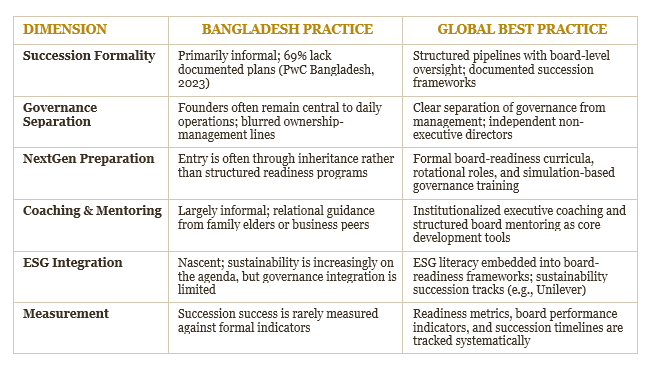
What is striking about this comparison is not the gap itself, gaps of this kind exist in many emerging markets. What is striking is the direction of movement.
As The Daily Star observed in October 2025, Bangladesh’s first-generation entrepreneurs have demonstrated extraordinary resilience and market acumen. The challenge now is to institutionalize that excellence into governance structures that outlast any individual, however brilliant (The Daily Star, 2025).
The tools to do so exist. The models are proven. The question is whether the will is present to deploy them with the urgency the moment requires.
More than an investment
I have been a coach for many years. I have worked in boardrooms and at the grassroots level, also in family offices and corporate headquarters. I have sat with founders at the twilight of their building years and with successors at the dawn of theirs. And in all of that time, I have arrived at one conviction that has never wavered: the quality of the conversation we have today about leadership will determine the quality of the organisation that exists tomorrow.
The third-generation leaders I sat with yesterday did not need to be convinced of this. They already felt it. They felt it in the dreams they shared around that table. They felt it in the moment they recognised themselves in one another’s aspirations. They felt it in the anthem they chose to close the day, that ancient, triumphant declaration that you are not alone in this, that your commitment is matched and multiplied by the commitment of those beside you.
What they need now is not inspiration. They have that in abundance. What they need is a system, a deliberate, sustained developmental pathway that takes those commitments and builds upon them the governance competencies, the self-awareness, the mentoring relationships, and the strategic literacy that the responsibility of board leadership genuinely requires.
AN INVITATION
This is Not Just an investment. It is the Foundation of Your Future.
I extend this invitation not merely as a professional call to action, but as a deeply personal one. I have sat in rooms where legacy met longing, where third-generation leaders held the weight of their founders’ dreams in one hand and the uncertainty of the future in the other. I have witnessed the precise moment when a question from a coach unlocks something that no boardroom agenda ever could: the truth of who someone is becoming.
If you lead a conglomerate, a family enterprise, or a multi-subsidiary group, I invite you to ask one honest question: “Are the people who will govern this company tomorrow truly prepared to do so today?”
NextGen Board Leadership Development is not an expense to be justified on a quarterly P&L. It is a talisman, a living, breathing act of stewardship for the legacy you have built, the people who depend on it, and the future generation that must carry it forward with both honour and innovation. Because one day, the only thing standing between your life’s work and its dissolution will be the quality of the leaders you choose to develop.
References
Chowdhury, T. (2024) ‘Square Group’s philosophy: professionalism as succession strategy’. Remarks at MCCI Seminar, ‘Where Family Values Meet Future Vision: Strategy for Sustainable Succession’, Dhaka, 2 September 2024.
Daily Star, The (2025) ‘Succession gap in Bangladeshi companies’. The Daily Star [Online], 12 October. Available at: https://www.thedailystar.net
Feroz, R. (2024) ‘Family corporate governance and the challenge of succession in Bangladesh’. Remarks at MCCI Seminar, Dhaka, September 2024. Reported in: TBS News, 2 September 2024.
Growth Shuttle (2025) ‘Family business survival in Bangladesh: navigating succession challenges for a sustainable future’. Growth Shuttle [Online], 1 October. Available at: https://growthshuttle.com
Harvard Business School (2023) ‘Corporate governance and board leadership’. Executive Education Programme Overview. Boston: Harvard Business School Publishing.
Heidrick & Struggles (2023) ‘Board effectiveness focus: best practices for family business succession planning’ [Online]. Available at: https://www.heidrick.com
International Finance Corporation (IFC) (2022) IFC Family Business Governance Handbook. 4th edn. Washington, DC: IFC.
Kotter, J.P. (1996) Leading Change. Boston: Harvard Business School Press.
PwC (2023) ‘Bangladesh Family Business Survey 2023: succession, governance and the next generation’. Dhaka: PricewaterhouseCoopers Bangladesh.
Quarterdeck (2025) ‘Future Leaders Programme: a complete guide to high-potential development’ [Online]. Available at: https://quarterdeck.co.uk
Reitsma, S.M. (2001) ‘Management development in Unilever’. Journal of Management Development, 20(1), pp. 59–75.
Russell Reynolds Associates (2023) ‘Family business governance: leadership succession and the multi-generational enterprise’ [Online]. Available at: https://www.russellreynolds.com
TBS News (2024) ‘Generational gamble: why Bangladesh’s family businesses often fail after the founders’. The Business Standard [Online], 2 September 2024. Available at: https://www.tbsnews.net.
TBS News (2024) ‘How to make a family business survive beyond the founder’. The Business Standard [Online], 26 February 2024. Available at: https://www.tbsnews.net
Together Platform (2025) ‘How to start a future leaders programme: examples included’ [Online]. Available at: https://www.togetherplatform.com