I did not meet him in a moment of crisis.
There were no headlines, no shareholder unrest, no visible fracture in the organization. From the outside, everything appeared intact: strong numbers, disciplined meetings, a board that functioned with practiced formality. He chaired a respected family-owned conglomerate in Dhaka’s commercial district, a man whose signature carried consequence. Yet when I entered that conference room, what I recognized as someone who works in board governance coaching was something far quieter than crisis. It was containment. The particular loneliness of a man who had become so indispensable to everything around him that he had quietly lost access to himself.
He chaired a respected family-owned conglomerate in Dhaka’s commercial district, a man whose signature carried consequence. Yet when he entered the room for our first session, what I noticed was not authority. It was containment.
He was in the conference room exactly on time. Tailored suit. The kind of presence that commands attention without asking for it. We sat across from each other, and he began talking immediately. About the board. About market challenges. About a managing director who didn’t quite understand the vision. About family members who needed managing.
I listened for fifteen minutes without interrupting.
Then I noticed something. In all his words about governance, about strategy, about people who worked for him and with him, he had not once used the word “I” in relation to himself.
It was always about them. Their failures. Their resistance. Their misalignment.
Never about him. And then there is a silence!
So, I resisted the temptation to demonstrate expertise. No frameworks. No performance grids. No intellectual sparring.
I let the silence stretch, respectfully and intentionally, until the room softened.
Then I asked, quietly, “What is it like to carry all of this?”
The question lingered.
He shifted almost imperceptibly, as if recalibrating expectations. I sensed he had prepared to be challenged. Perhaps evaluated. Possibly corrected.
Instead, he was being met.
Then he said, almost in passing:
“No one asks how I am managing all this.”
That was the first moment the title receded and the human being emerged.
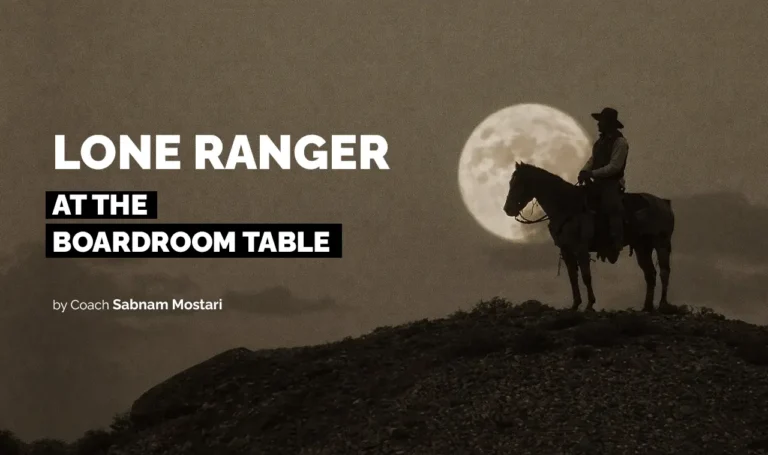
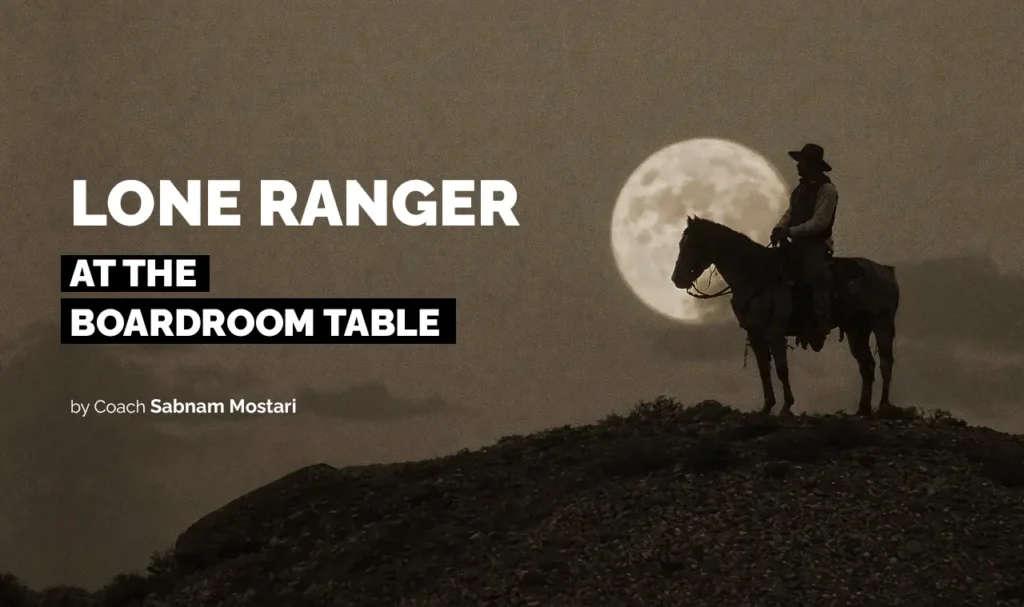
The Lone Ranger! The Architecture of Invulnerability
Normally, Leaders at the top often develop a refined architecture of composure. It is not arrogance. It is survival. Authority demands steadiness. Vulnerability risks misinterpretation. Fatigue becomes a liability. Over time, this architecture becomes so elegant that even the leader forgets where the entrance is. Here’s what I’ve learned about chairmen, particularly in family businesses. They occupy the loneliest position in any organization. And day by day, they transformed into a “Lone Ranger”!
Everyone looks to them. Everyone waits for their signal. When they speak, people lean in. When they’re quiet, people worry.
But who do they lean on?
The board expects leadership. The family expects fairness. Shareholders expect returns. Employees expect stability. The community expects responsibility. And the chairman? The chairman is expected to hold it all together without breaking.
Over time, this creates a particular kind of isolation. Not the isolation of being alone in a room. But the isolation of being surrounded by people who cannot or will not see your humanity.
You become the chair, not the person sitting in it.
So, definitely, this feature has been visible in our session. In our early sessions, his language was defensive, like- “They are not aligned.” “I cannot rely fully on the board.” “I must remain firm.”
Each sentence was structured like a boundary wall. I did not dismantle those walls. I listened around them.
What Happens When You Cannot Speak
In our second session, I asked him about his board. “They’re capable,” he said. “But I can’t fully trust them with certain decisions.”
“What happens if you do?”
“They might make the wrong choice.”
“And then?”
He paused. “Then I’ve failed in my responsibility.”
There it was. The equation that had been running in his mind for years.
Trust equals risk! Risk equals failure! Failure equals his fault!
So don’t trust. Don’t risk. Control everything.
It’s an understandable logic. And it’s slowly suffocating. Because when you can’t trust your board, you can’t use your board. And when you can’t use your board, you’re governing alone. And when you’re governing alone, every decision sits on your shoulders. Every problem lands on your desk! Every worry lives in your head at 3 AM!
You become both the decision-maker and the only person who fully understands the weight of each decision!
That’s not leadership! That’s imprisonment!
The Language of Defense
I started noticing patterns in how he spoke-
When discussing a failed initiative: “They didn’t execute properly.”
When talking about board resistance: “They don’t see the bigger picture.”
When explaining delays: “I had to step in and fix it myself.”
Every sentence had a fortress around it. Every explanation placed him on one side and everyone else on the other.
I didn’t challenge these statements directly. That would have triggered more defense. Instead, I started asking different questions.
Not “What did they do wrong?” but “What made that situation difficult?”
Not “Why don’t they understand?” but “What are they seeing that concerns them?”
Not “What did you have to fix?” but “What would it have looked like if you didn’t step in?”
Slowly, the fortress language started shifting.
“They didn’t execute” became “I didn’t give them enough context.”
“They don’t see the bigger picture” became “I haven’t painted that picture clearly enough.”
“I had to fix it” became “I stepped in too quickly before they could find their own solution.”
These weren’t just word changes. They were perspective shifts. And perspective shifts are where transformation begins.
The Day He Said He Was Tired
It happened in our fourth session. We had been talking about succession planning. He was outlining his concerns about the next generation, their readiness, their commitment. His tone was measured, analytical, controlled.
Then he stopped mid-sentence.
Just stopped.
I waited.
He looked out the window at Dhaka’s skyline, buildings stacked against buildings, the city that never quite rests. “I’m tired,” he said.
Not tired of the work. Not tired of the company. Just tired. A deep, accumulated fatigue that had been there so long he’d forgotten what it felt like not to carry it.
“I‘m tired of being the only one who can’t afford to be uncertain. Tired of holding every decision. Tired of being strong all the time.”
He said it quietly, almost to himself. As if admitting it out loud might make it more real, more dangerous. But something important happened in that moment. He didn’t collapse. He didn’t weaken. He didn’t lose authority. He became human.
And that humanity, paradoxically, made him more capable of leading, not less!
Governance is not Control: Governance vs Control
We started working on something fundamental. The difference between governance and control. Control is what you do when you’re afraid. You hold decisions close. You monitor everything. You intervene early and often. You make yourself indispensable because if you’re indispensable, you’re safe.
Governance is different.
Governance is setting direction and holding accountability while trusting others to navigate the path. It’s creating conditions for good decisions rather than making every decision yourself. It’s building a system that works even when you’re not in the room.
Control protects you. Governance builds the organization. I asked him to try something uncomfortable. To bring an issue to the board without having already decided the answer. “But what if they choose the wrong direction?” he asked. “Define wrong.”
He couldn’t. Not clearly. Because “wrong” often just meant “different from what I would have chosen.” So, he tried it. A strategic question about market expansion. He presented the context, the options, and the implications. Then he asked for their input and genuinely listened. The board debated. Some directors saw risks he hadn’t considered. Others saw opportunities he’d overlooked. Together, they arrived at a decision that was actually better than the one he’d been carrying in his head. After the meeting, he looked shaken.
“That was terrifying,” he said.
“What was terrifying about it?”
“I wasn’t in control.”
“But did it go badly?”
“No. It went well. That’s what’s terrifying.”
I understood. Because if the board can make good decisions without him controlling every variable, then what exactly is his role? And if he’s not the sole source of wisdom, who is he?
These are the questions that shake a chairman’s identity. And they’re necessary questions.
When The Room Starts Breathing
The changes weren’t dramatic.
He started asking more questions in board meetings. He started presenting uncertainties instead of only presenting certainties. He started inviting directors into earlier stages of strategic thinking.
Board members noticed. At first, some were confused. Was this a test? Was he checking loyalty?
But over time, they realized it was genuine. He actually wanted their input. He actually trusted them to think.
Something shifted in the room.
Directors started speaking more freely. Debates became richer. Silence no longer meant agreement out of politeness. Disagreement no longer felt dangerous.
The audit committee chair told me later, “It’s like we’re finally allowed to do our jobs.”
That phrase stayed with me. “Allowed to do our jobs.”
Because that’s what happens when a chairman moves from control to governance. He allows people to do what they were appointed to do. He stops being the bottleneck and becomes the facilitator.
The board started functioning like a board, not like an audience.
The Myth of the Strong Leader
There’s a myth in Bangladesh’s corporate culture. Maybe everywhere. The myth that strength means standing alone. That vulnerability is a “weakness”. That asking for help is a “failure”.
This myth is particularly strong at the top. CEOs feel it. Chairmen feel it acutely.
They believe they must project invulnerability. Certainty. Complete control. Because if they show doubt, if they admit fatigue, if they acknowledge fear, then people will lose confidence. The organization will destabilize. Everything will fall apart.
But here’s what actually happens.
When a leader hides his humanity, people don’t see strength. They see distance. They see someone unreachable, unknowable, untrusted because he trusts no one!
And that distance doesn’t inspire. It isolates! The strongest thing this chairman did was admit he was tired. Because that admission opened the door for honesty throughout the organization. If he can be human, maybe they can too. If he can be uncertain, maybe uncertainty is okay. If he needs support, maybe it’s not a weakness to ask for it.
Leadership isn’t performed in invulnerability. Leadership is the courage to be real while holding responsibility.
What I’ve Learned About Coaching the Top
Coaching a chairman is nothing like coaching a manager.
Managers have bosses to report to. Chairmen don’t. Managers work within systems. Chairmen create systems. Managers can show uncertainty. Chairmen feel they can’t.
So the work becomes different.
It’s not about skill development. Most chairmen are highly skilled. It’s not about knowledge transfer. They usually know plenty.
It’s about creating a space where the person behind the title can emerge. Where the human being carrying all this weight can set it down, even briefly, without consequence.
That space requires some specific things.
Complete confidentiality. They need to know nothing leaves the room.
No agenda beyond their wellbeing. They’re surrounded by people who want something from them. The coach must want nothing except their growth.
Deep listening without judgment. Not to advise. Not to fix. Just to witness their reality without collapsing under it or minimizing it.
Patience with their defenses. Those defenses were built for good reasons. They won’t dissolve quickly. And they shouldn’t.
Respect for the loneliness. Not trying to eliminate it, but acknowledging it exists and that it’s real and that it matters.
Patterns I Keep Seeing in Board Governance Coaching
After years of this work, I notice patterns.
The controlling chairman, who believes he’s protecting the organization but is actually preventing it from growing.
The conflict-avoidant chairman, keeps peace at the expense of truth, until unspoken tensions poison the culture.
The patriarch chairman, who confuses family harmony with governance effectiveness, treating board disagreement as personal betrayal.
The legacy-obsessed chairman, who can’t let go because his identity is completely merged with the organization.
The isolated chairman, who has risen so high that nobody tells him the truth anymore, leaving him to govern based on incomplete information and his own echo chamber.
Each pattern creates its own dysfunction. Each requires different work. But they all share one thing.
Underneath the pattern is a person trying to do something impossible: be perfect, invulnerable, always right, never uncertain, constantly strong.
And that impossibility is crushing them.
The Turn Toward Trust
Somewhere in our journey together, something changed.
He came to a session and started talking differently. Not about what the board wasn’t doing. But about what he wasn’t doing.
“I realized I’ve been treating board meetings like performances I need to control,” he said. “I prepare everything in advance. I anticipate objections. I have responses ready. I’m managing the room instead of facilitating it.”
“What would facilitating look like?”
“I don’t know. That’s the problem.”
So we explored it.
Facilitating means creating conditions for good thinking, not doing all the thinking yourself.
It means asking questions that open up the conversation, not questions designed to steer toward your predetermined conclusion.
It means allowing silence when people are thinking, not filling every gap with your own voice.
It means trusting that the collective wisdom in the room might exceed your individual wisdom.
That last one was hardest.
Because trusting collective wisdom means accepting that you might not have the best answer. And if you’re the chairman, if you’ve built your identity on being the person with answers, that’s terrifying.
But he started trying it.
Small experiments at first. Asking a question and not jumping in with his view immediately. Letting someone else synthesize the discussion instead of doing it himself. Acknowledging when he genuinely didn’t know the answer instead of pretending certainty.
The board responded.
Not with loss of confidence. With relief.
Because they’d been carrying the weight of his need to control just as much as he’d been carrying the weight of the organization. When he relaxed, they could breathe.
What this Means for Governance
Board governance in Bangladesh often operates on an unspoken assumption: the chairman knows best, and the board’s job is to support his vision. This works, sometimes, in the short term. Especially if the chairman is brilliant.
But it fails in the medium to long term. Because it creates a single point of failure. Everything depends on one person’s judgment, one person’s health, one person’s availability.
And more subtly, it prevents the organization from developing its own governance capacity. Board members don’t learn to think strategically because they’re not asked to. They don’t develop collective accountability because accountability is centralized in one person.
When the chairman finally steps down or something happens to him, the organization discovers it doesn’t know how to govern itself. Because it never had to.
Real governance builds capacity.
It distributes wisdom across multiple minds. It creates systems that outlast individuals. It develops directors who can think independently while working collectively.
But that requires the chairman to let go. Not of responsibility. Of control.
And letting go of control requires trust. And trust requires vulnerability. And vulnerability requires safety.
Which is why coaching at this level matters. Because we’re not just working on one person’s leadership. We’re working on the conditions that allow an entire governance system to function.
Tips for Coaching the Lone Ranger
If you find yourself coaching a chairman, a CEO, or someone at the absolute top, here’s what I’ve learned.
Start with deep respect: They didn’t arrive at that position by accident. They’ve achieved something real. Honor that before you challenge anything.
Create total safety: They’re surrounded by people who judge them, need things from them, and watch their every move. Your space must be different. Completely confidential. Entirely non-judgmental. A sanctuary from performance.
Don’t rush into problem-solving: The temptation is to hear their challenges and immediately offer solutions. Resist. They don’t need your solutions. They need space to discover their own.
Listen for what’s not being said: The real issue is rarely the first thing they mention. It’s underneath. Listen for the pattern, the emotion, the fear they can’t quite name.
Name the loneliness: They might not call it that. They might call it “being strategic,” or “maintaining boundaries,” or “protecting the organization.” But often, it’s loneliness. And naming it makes it manageable.
Work with their defenses, not against them: Those defenses serve a purpose. Don’t try to dismantle them. Help them notice when defenses are protecting them and when defenses are limiting them.
Invite don’t push: They’ve been pushed their whole careers. By markets, by boards, by expectations. An invitation works better than pressure. “Would you be willing to try…” instead of “You should…”
Normalize their experience: They often think they’re the only one struggling with these feelings. They’re not. Letting them know that other leaders face similar challenges doesn’t minimize their experience. It contextualizes it.
Separate the person from the position: Help them see themselves as distinct from their role. The chairman is a position they hold. It’s not who they are. This distinction creates freedom.
Celebrate small shifts: They’re used to big wins, dramatic changes, measurable results. Board-level transformation is subtle. A different question asked in a meeting. A moment of vulnerability shared. These matter. Acknowledge them.
Be patient with pace: They’ve been building their leadership approach for decades. It won’t change in three sessions. Trust the process. Trust their readiness. Don’t force growth before they’re ready to receive it.
Stay curious, not certain: The moment you think you’ve figured them out is the moment you’ve stopped seeing them. Stay curious. Keep asking. Keep wondering. They’ll sense the difference.
What Changes When Power Breathes
Toward the end of our time together, he told me something I think about often.
We were in that same conference room where we’d started. Nine months had passed. The board had evolved. His relationship with them had shifted. The organization felt different, though few could name exactly what had changed.
“I thought coaching would make me better at controlling things,” he said. “I didn’t realize it would teach me to stop trying to control everything.”
That sentence captures it perfectly. Because when a chairman learns to breathe, when he stops holding everything so tightly, something remarkable happens throughout the entire organization.
Trust flows downward: People stop waiting for permission and start taking initiative.
Innovation increases: When failure isn’t catastrophic, people try new things.
Succession becomes possible: When leadership isn’t monopolized by one person, others can practice leading.
Accountability grows: When the chairman doesn’t rescue everything, people learn to be responsible for their own areas.
Culture shifts: From fear-based compliance to genuine engagement.
These changes don’t happen overnight. They accumulate slowly, like water shaping stone. But they’re real. And they’re profound.
An Invitation to the Lone Rangers Everywhere
If you’re reading this and you recognize yourself, if you’re the chairman or CEO or founder who carries everything, who can’t quite trust anyone else to hold what you hold, who’s forgotten what it feels like not to be on guard, I want to say something to you.
You don’t have to do this alone.
I know you think you do. I know the myths you’ve absorbed about leadership and strength and responsibility. I know how hard you’ve worked to get where you are. I know what’s at stake.
But the cost of your isolation isn’t just personal. It’s organizational.
When you won’t let anyone close enough to help you, you prevent the organization from developing its own capacity. When you hide your uncertainty, you teach everyone else to hide theirs. When you can’t trust your board, your board learns not to trust each other.
Your loneliness cascades.
But here’s the good news. When you begin to open up, when you start to share the weight, when you let people see you as human, that cascades too.
Courage flows downward. Trust multiplies. Strength becomes collective instead of individual.
You don’t need a coach to start this work. You can start right now.
Ask yourself: What would happen if I told my board I don’t have all the answers?
What if I admitted I’m struggling with a decision?
What if I asked for help?
What if I let someone else lead the meeting?
What if I stopped performing invulnerability and just showed up as I am?
These questions might terrify you. They should. They’re asking you to risk something precious: your carefully constructed image of unshakeable leadership.
But that image is costing you more than you realize.
And the organization you’re protecting by maintaining that image? It needs you to let it go. Because it can’t grow while you’re holding everything.
My Reflections
That chairman and I don’t work together anymore. Our engagement ended after a year. He didn’t need me anymore. Not because everything was perfect. But because he’d learned to create the conditions for his own growth.
He still chairs the board. He’s still responsible for enormous decisions. He still carries weight that would crush most people. But he carries it differently now.
He has a colleague on the board he talks to honestly. He has a practice of pausing before reacting. He asks his wife how he’s really doing instead of pretending everything’s fine. He takes one day a month completely off, something he hadn’t done in fifteen years.
Small things. Quiet things. The kind of changes no analyst would notice in a quarterly report.
But the board notices. The culture notices. His family notices.
And he notices. He told me in our last session that he sleeps better now. That’s the metric he’s most proud of. Not market share or revenue growth. Sleep.
Because sleep means you’re not carrying the whole world into your bedroom at night. Sleep means you’ve set something down. Sleep means you trust that the sun will rise tomorrow whether you’re controlling everything or not.
I think about him sometimes when I work with other leaders who are trapped in the same pattern. The same isolation. The same belief that they must be invulnerable.
And I think about what happens when power learns to breathe.
It doesn’t become weak. It becomes sustainable.
It doesn’t lose authority. It gains humanity.
It doesn’t fail the organization. It frees the organization to become what it’s meant to be.
The Lone Ranger doesn’t need to ride alone. He just needs someone to remind him that the circle is still there, waiting for him to return.
And when he does, everyone breathes easier.
Key Takeaway
The Core Shift: Governance vs Control
One of the most difficult transitions for a “Lone Ranger” chairman is understanding the fundamental difference between governance vs control. Control is defensive; it is a mechanism used when a leader fears failure or misalignment. Governance, however, is a proactive system of setting direction and holding accountability while trusting the board to navigate the path. Moving from control to governance allows the organization to breathe and grow beyond the limitations of a single individual.
Breaking the Cycle of Executive Isolation
At the top of a conglomerate, the “architecture of invulnerability” often leads to profound executive isolation. When a chairman feels they must be the sole source of wisdom, they inadvertently silence the collective intelligence of the room. This isolation is not just a personal burden; it is a strategic risk. Breaking this cycle requires the courage to admit fatigue and the willingness to be “met” as a human being, not just as a title.
The Impact of Boardroom Leadership Psychology
Effective leadership at the board level is less about technical skills and more about boardroom leadership psychology. It involves understanding the emotional undercurrents of the room, the “dance of deference” and the “language of defense.” When a chairman learns to facilitate rather than dictate, they transform the boardroom from a place of performance into a space of genuine, high-level strategic inquiry.
The Value of Chairman Coaching in Bangladesh
Given the unique dynamics of family-owned conglomerates, chairman coaching in Bangladesh serves as a vital sanctuary. In a business culture that often values hierarchy and “face,” a coach provides a neutral, confidential space to set down the weight of leadership. This specialized support allows chairmen to transition from being the “bottleneck” of the organization to becoming the facilitator of its long-term sustainability.